
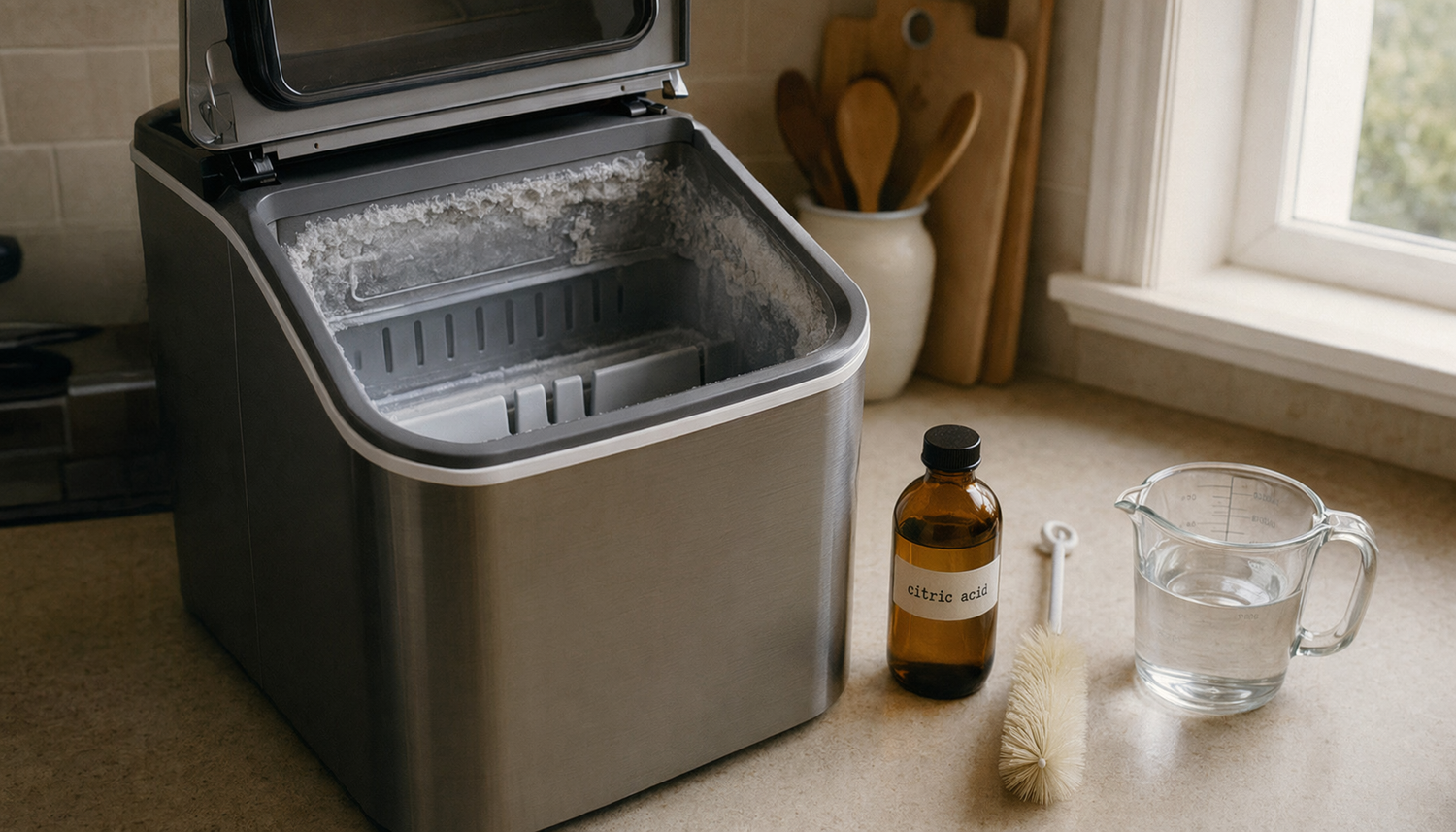
For most ice makers, citric acid is the better choice when scale is stubborn, while vinegar is the more practical option for light buildup and routine upkeep.
If your ice starts tasting off, the machine gets louder, or a white film keeps coming back inside the reservoir, you are usually dealing with mineral scale rather than a refrigeration failure. The good news is that the right descaling method can often restore normal ice production, reduce repeat buildup, and help you decide whether a quick home cleaning is enough or a heavier-duty cleaner is the smarter move.
Why Ice Makers Build Up Scale So Quickly

Portable countertop units, undercounter machines, and light-duty commercial ice makers all concentrate minerals as they freeze water. A public agency notes that ice makers need periodic cleaning to remove lime and scale, and that routine process matters because ice machines use water not only to make ice, but also in operating cycles that leave deposits behind over time.
In real-world use, this buildup shows up first as chalky residue, cloudy ice, slower batch times, or a machine that seems to run longer than usual. In a portable unit used in an RV, break room, or weekend cabin, scale often collects around the water tray, pump area, and small internal tubing. In a café, bar, or office setup, the problem tends to be more persistent because the machine runs longer each day and the incoming water supply may be harder.
Scale is not just a cosmetic issue. Lint, grease, and mineral buildup can reduce operating efficiency and ice output, which is why public health guidance for ice machines also calls for regular cleaning of filters, condensers, and machine-specific components based on the manufacturer’s instructions for each make and model.
Is Citric Acid Better Than Vinegar?

When citric acid makes more sense
For heavy mineral deposits, citric acid usually has the edge because it is commonly used in dedicated descalers meant to break down scale more efficiently than kitchen pantry solutions. Household vinegar is often presented as a workable homemade option, but it is also described as best for light to moderate scale, while stronger ice machine cleaners are better for heavy buildup, recurring deposits, or faster descaling.
That distinction matters in practice. If a portable ice maker has been stored for months with hard-water residue inside, or a small commercial unit has visible white crust around the evaporator area, vinegar may still help, but it may take more than one cycle and more rinsing. A citric acid-based or manufacturer-approved descaler is usually the better fit when you want to cut through repeat scale without running multiple cleaning attempts.
When vinegar is still a good choice
Vinegar helps dissolve limescale and loosen stale odors, so it remains a sensible first step for routine maintenance on countertop ice makers and other light-use appliances. It is easy to find, inexpensive, and often good enough when the machine is still making normal ice and the residue is minor.
That makes vinegar especially practical for home kitchens, travel trailers, guest rooms, and occasional-use beverage stations where you want a simple maintenance routine instead of stocking a separate descaler. If the buildup is light and you can rinse thoroughly, vinegar is usually the easiest starting point.
Odor, Taste, and Residue: Where Vinegar Loses Ground

The biggest downside of vinegar is not usually descaling power. It is the smell and the chance that the next batch of ice picks up a sour note if rinsing is incomplete. A standard vinegar cleaning process often requires a full drain, then potable-water circulation and draining two to three times, followed by one to two fresh-water ice cycles that should be discarded before normal use resumes.
That extra flushing is manageable at home, but it becomes less convenient when the machine is used often. In a small office or event setup, losing several ice cycles after cleaning can be annoying. In a coffee bar or beverage counter, it can interrupt service during a busy part of the day.
Citric acid-based descalers are often preferred for this reason even when the scale is only moderate. They are chosen less for marketing claims and more for workflow: quicker rinse-out, less lingering odor, and less chance that guests notice a flavor carryover in the next round of ice. If taste complaints are your main issue, vinegar can still work, but it requires more careful follow-through.
Material Compatibility and Safety for Ice Maker Parts

Follow the machine before the chemical
The safest rule is simple: the machine manual comes first. Public health guidance for commercial equipment says cleaning depends on the specific make and model, and manufacturers may limit which cleaners can be used on internal metals, pumps, seals, or non-removable water-contact parts.
This is especially important with portable ice makers because their internal pumps, reservoirs, and tubing are compact and not always designed for aggressive soaking. A short descaling cycle may be fine, while a long soak in a strong acid mix may not be. If the manual specifies a branded cleaner, a citric acid cleaner, or a precise dilution, that instruction should override generic internet advice.
Avoid mixing cleaning and sanitizing steps
Cleaning and sanitizing are separate steps, and that distinction matters for ice makers. Descaling removes mineral deposits. Sanitizing, when required by the manufacturer or local food-service rules, is a separate process with its own approved chemistry and rinse requirements.
That is one reason vinegar should not be treated as a cure-all. It can help with scale and odor, but it does not replace a required sanitizing step. It also should never be mixed with bleach or other chlorine products, because acid-chlorine combinations can create dangerous gas. If you are cleaning a home unit, keep the process simple: descale first, rinse completely, then follow any approved sanitizing instructions separately if your model calls for them.
How to Descend the Right Way Without Creating New Problems

A practical vinegar method for portable and home units
A common vinegar routine is to power the machine off, empty the water and ice, remove the basket and scoop, wash removable parts, wipe the interior with a diluted solution, run a cleaning or normal cycle, then drain completely. For routine wipe-downs and many internal cleaning cycles, a 1:10 vinegar-to-water approach is typically enough, while a 1:1 mix is better reserved for short soaks of removable parts that can be rinsed fully.
For most countertop units, this is enough when the issue is early scale, stale taste, or seasonal storage residue. If the machine is used only on weekends or for parties, that lighter approach is usually more practical than going straight to a commercial descaler.
A better method for heavier scale
Commercial ice maker cleaner or descaler is often recommended for mineral buildup, especially once you can see visible deposits inside the housing. In a light-business setting, that is usually the better route because repeated weak cleanings waste time, water, and ice production.
If you switch to a stronger descaler, do not improvise concentration or contact time. A standards organization’s cleaning guidance stresses correct dilution, full rinsing, and removal of detergent or chemical residue before the next step. For inaccessible food-contact zones, written clean-in-place instructions from the manufacturer are the safest reference point.
How Often Should You Descale an Ice Maker?

How often you descale depends mostly on water hardness and how many cycles the machine runs. For routine home use with soft to moderately hard water, descaling every four to eight weeks is a practical baseline. If your water is hard, or the machine runs daily in a garage bar, office kitchenette, or small beverage service area, every two to four weeks is more realistic.
That schedule is more aggressive than the broad six-month deep-clean advice sometimes given for household ice equipment because countertop and portable machines tend to have smaller water paths and less tolerance for mineral buildup. Commercial-style units may also need extra attention in poor-water areas or whenever scale becomes visible.
Do not rely only on the calendar. Clean earlier if ice turns cloudy, the machine gets louder, the batch slows down, the bin develops off odors, or you see white residue around the reservoir or internal surfaces. Those signs usually mean the next cleaning cycle should happen now, not next month.
FAQ
Q: Can I use vinegar in any ice maker? A: Not automatically. Vinegar is widely used for light descaling, but the machine manual should decide. Some manufacturers specify exact cleaners, approved sanitizers, or cleaning-cycle steps for internal components and food-contact areas.
Q: Will vinegar make my ice taste bad afterward? A: It can if you do not rinse thoroughly. After a vinegar cleaning, multiple potable-water flushes and one to two discarded ice cycles are often needed before the taste returns to normal.
Q: Is citric acid always the best option? A: No. It is usually the better choice for heavier scale or repeat buildup, but a light vinegar cleaning is often enough for routine maintenance on portable and home ice makers. The best option is the one your machine allows and your buildup level actually requires.
Practical Next Steps
If the scale is light, start with vinegar because it is easy, inexpensive, and usually effective enough for routine cleaning in home and travel-use ice makers. If the machine has recurring deposits, visible crust, or repeated taste problems, move to a citric acid-based or manufacturer-approved descaler instead of repeating weak vinegar cycles.
For any portable, undercounter, or light-commercial ice maker, the best long-term fix is not just the cleaning chemical. Match your descaling schedule to your water hardness, rinse more thoroughly than you think you need to, discard the first fresh ice after cleaning, and follow model-specific instructions whenever internal pumps, tubing, or non-removable ice-contact parts are involved.

Dejar un comentario
Este sitio está protegido por hCaptcha y se aplican la Política de privacidad de hCaptcha y los Términos del servicio.