
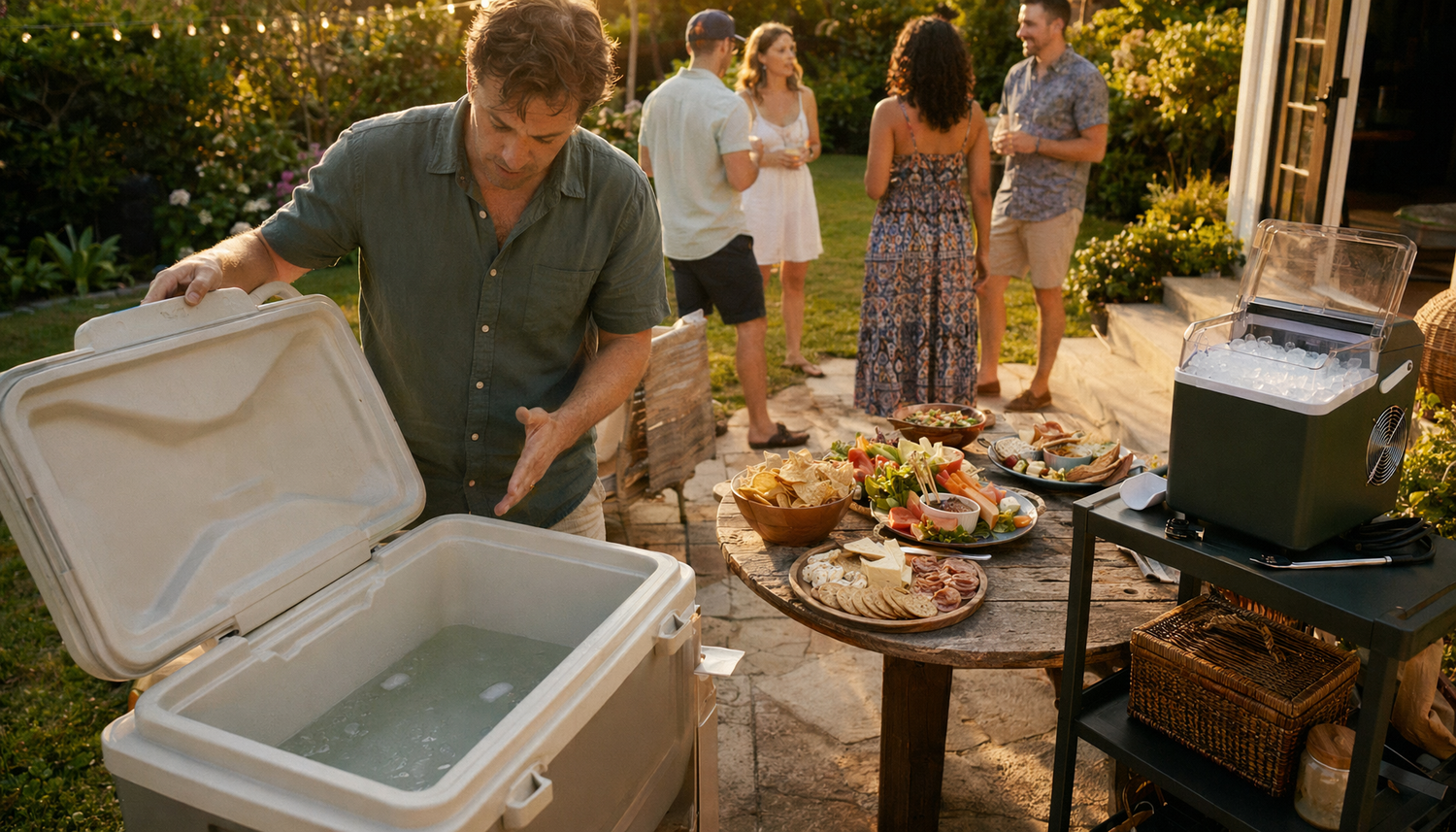
When the ice is gone, protect perishable food first, then re-stage drinks with the cold storage you still have. A portable ice maker can help recover, but a beverage cooler, refrigerator, or car refrigerator often does a better job of holding drinks at serving temperature.
When the cooler is full of water and the last bag of ice is gone, the problem is no longer just warm soda. In summer heat above 90°F, perishable foods only get about 1 hour before they pass the usual food-safety limit, and many countertop ice makers make fresh ice gradually instead of all at once. The fastest recovery plan is to protect food, reorganize drinks, and use the right backup appliance for the rest of the party.
Protect Food Before You Rescue the Drinks

Move high-risk foods first
Cold perishable foods need to stay at 40°F or below. If the ice bath under shrimp, deli trays, cut melon, cheese boards, dairy dips, or sandwich platters has melted, move those foods into a refrigerator, beverage cooler, or a freshly packed cooler with ice packs before you worry about canned drinks.
Perishable food follows the 2-hour rule: refrigerate it within 2 hours, or within 1 hour if the outdoor temperature is above 90°F. That matters at backyard cookouts and holiday weekends because a party table can look fine long after the safe holding window has passed.
Separate drinks from anything that can spoil
Packing beverages separately from perishable foods cuts down on cooler opening and helps the colder space last longer for the food that actually needs it. In practice, that means beer, soda, canned cocktails, and bottled water can be re-staged in the kitchen refrigerator, a beverage cooler, or even a secondary cooler, while food gets the coldest and least-disturbed storage.
If the party issue is tied to a power outage, an unopened refrigerator stays cold for about 4 hours, while a full freezer can hold safe temperatures for about 48 hours. Keep the doors closed as much as possible, and do not taste food to decide whether it is still safe.
Keep Drinks Cold Without Wasting the Rest of the Night

Chill in smaller waves
A melting party tub is a poor long-hold solution once the ice is gone, so switch to batch service. Move only the next round of drinks into the coldest space you have, serve those first, and keep the rest inside a refrigerator or beverage cooler instead of leaving every bottle outside at once.
Cold service works better when small backup platters and portions stay refrigerated until needed, and the same logic applies to beverages. For example, instead of icing 48 cans at once, keep most of the case in a beverage cooler or kitchen refrigerator and rotate out 8 to 12 cans at a time for the next group of guests.
Match the drink type to the storage type
Already-cold canned drinks are easy to hold in a beverage cooler or car refrigerator. Bottled mixers, cut citrus, dairy-based cocktail ingredients, and opened juice need true cold holding, so they belong in a refrigerator, beverage cooler, or well-packed cooler that can stay at safe temperature, not in a shallow tub of warm meltwater.
For mixed-drink setups, cold foods and ingredients should stay at 40°F or colder. That is why a beverage cooler or compact car refrigerator can be more useful than a last-minute bag of ice when the real problem is keeping tonic, juice, garnishes, and pre-batched drinks consistently cold through repeated opening.
Choose the Right Backup Appliance for the Situation

Portable ice maker vs. beverage cooler vs. car refrigerator
If you still have power, the best backup depends on whether you need new ice, colder drinks, or safe storage for ingredients. A portable ice maker creates fresh ice for cups and small buckets. A beverage cooler protects already-cold cans and bottles. A car refrigerator helps when the party is mobile, outdoors, or far from the kitchen.
Retail listings for countertop ice makers commonly advertise about 8 to 9 bullet cubes in roughly 6 minutes and up to about 26 lb of ice in 24 hours under favorable conditions. That sounds fast, but the trade-off is important: daily output is not the same as instant storage, so these machines are useful for topping up drink service, not for instantly replacing a large cooler full of melted party ice.
Appliance |
Best use during a party |
Main strength |
Main trade-off |
Portable ice maker |
Replacing drink ice for cups, pitchers, and small ice buckets |
Makes fresh ice on site without a store run |
Produces ice gradually and usually stores only a small batch at a time |
Beverage cooler |
Holding soda, beer, bottled water, mixers, and wine at serving temperature |
Stable cold storage with easy organization |
Does not make ice |
Car refrigerator |
Tailgates, patios, RV trips, beach houses, and overflow cold storage |
Portable cold holding for drinks and perishables |
Limited space compared with a full-size refrigerator |
Larger dedicated ice machine |
Frequent hosting or light-business drink service |
Higher output for recurring demand |
More space, cost, and planning than occasional hosts need |
Pick by use case, not by marketing speed alone
A portable ice maker is the practical choice when guests mainly need fresh cubes for soft drinks, highballs, iced coffee, or a small cocktail station. A beverage cooler makes more sense when you already have cold inventory and want to avoid opening the main refrigerator every few minutes. A car refrigerator is especially useful for tailgates, pool houses, cabins, or patios where the kitchen is too far away to be convenient.
For light-business use, such as a small event space, pop-up beverage stand, or recurring holiday entertaining, daily demand is the deciding factor. If every weekend involves multiple coolers, seafood displays, bottled mixers, and heavy cocktail service, stepping up from a countertop unit to a larger dedicated ice setup is usually more realistic than depending on emergency bag-ice runs.
Plan Better for the Next Summer Party

Estimate demand by what guests are actually doing
Drink ice and food-holding ice disappear at different rates. A casual cookout with canned drinks may only need steady top-offs, while a cocktail-heavy gathering uses ice twice: once for chilling drinks and again for serving them. That is why a countertop unit that makes up to around 26 lb per day can be enough for a small backyard party, but it usually will not cover multiple large coolers and full cocktail service by itself.
Cold buffet food should stay 40°F or colder, so it helps to keep backup trays inside and refill the table in smaller rounds. For a practical home setup, separate your plan into three jobs: drink ice, drink storage, and food safety. Once you do that, it becomes easier to see whether you need more ice production, more refrigerated space, or both.
Build a two-layer setup
A reliable party setup usually has one appliance making or holding ice and another appliance holding drinks. For example, a host might use a countertop ice maker near the serving area, a beverage cooler for soda, beer, and canned cocktails, and the main kitchen refrigerator for dairy dips, cut fruit, and food prep. For travel or tailgate use, a portable ice maker can pair well with a car refrigerator so the drinks and perishables are not competing for the same melting cooler space.
Food safety also depends on airflow and temperature stability. Do not overpack the refrigerator, and use a thermometer if you host often enough that the appliance stays full during holidays and peak summer weekends.
Reset, Store, and Get Ready for the Next Season

Handle leftovers correctly
Leftovers, opened platters, and prepared ingredients should be refrigerated within 2 hours, or within 1 hour above 90°F. If you are cleaning up after a long party, divide large leftovers into shallow containers so they cool faster instead of stacking one deep container in the back of the refrigerator.
If hot buffet dishes were served alongside cold drinks, remember that hot foods need a different target. Hot buffet items should stay at 140°F or warmer, so once they fall out of range, they need to be reheated correctly or discarded rather than left on a low warmer all evening.
Seasonal storage matters
Summer appliances often sit unused once the season changes, so end-of-season storage should be simple and dry. Empty any standing water, wipe down baskets and bins, clean the interior, and let the unit dry before storing it for winter. That reduces startup hassle when the next holiday weekend arrives.
For hosts who only entertain heavily from Memorial Day through Labor Day, this is also the best time to review what actually ran short: drink ice, refrigerated space, or both. That one note will tell you whether next season calls for a bigger ice machine, a dedicated beverage cooler, or just a better split between drink storage and food storage.
FAQ
Q: Can I keep party food safe in a cooler after the ice melts? A: Only if you restore a cold source quickly and keep the cooler at 40°F or below. Perishable foods should be discarded after 2 hours at room temperature, or after 1 hour if the weather is above 90°F.
Q: Is a portable ice maker enough for a large summer party? A: Usually not by itself. Countertop units are useful for supplementing drink ice, but they make ice in cycles and often store only a small amount at one time, so they are better for topping up service than replacing several bags of cooler ice all at once.
Q: When is a beverage cooler or car refrigerator better than buying more ice? A: It is the better choice when your drinks and mixers are already cold and you need stable holding for hours, especially during tailgates, patio parties, RV trips, and repeat hosting. You may still want some fresh ice for cocktails, but refrigerated holding solves a different problem.
Practical Next Steps
If you run out of ice mid-party, move perishable food indoors first, split drinks away from food, and use the coldest appliance you have for the items that spoil fastest. For future events, treat ice production and cold storage as separate needs: a portable ice maker helps with fresh cubes, while a beverage cooler, car refrigerator, or larger dedicated unit handles the steady job of keeping summer drinks ready to serve.

Hinterlasse einen Kommentar
Diese Website ist durch hCaptcha geschützt und es gelten die allgemeinen Geschäftsbedingungen und Datenschutzbestimmungen von hCaptcha.