
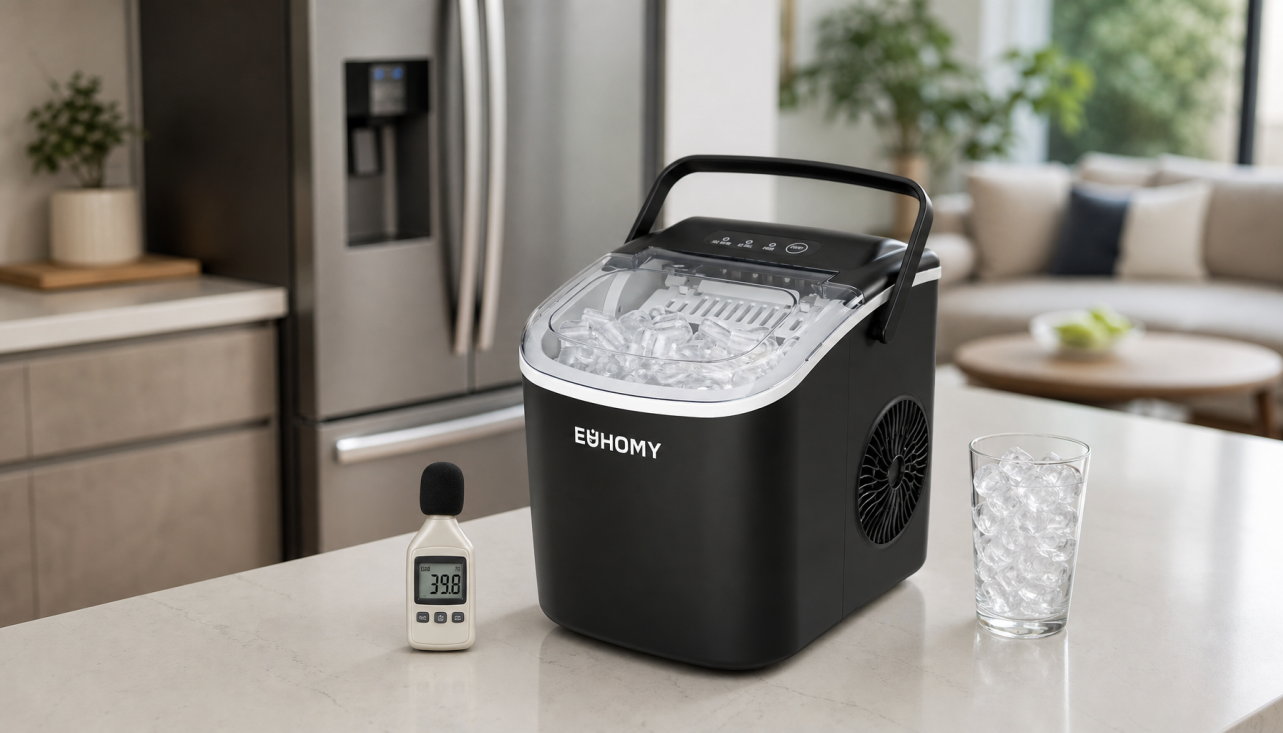
For most shoppers, a countertop ice maker feels quiet when it stays close to refrigerator sound, around 40 to 43 dBA, instead of edging toward the 55 dBA range of normal conversation.
If your ice maker kicks on during a late-night drink refill or a work call, the noise question stops being theoretical fast. Real appliance support notes and hands-on testing both show that even well-made portable units change sound as they cycle through pumping, cooling, and dropping ice. You will leave with a practical way to judge what is acceptably quiet, what is normal, and what setup changes actually help.
What “quiet” usually means for a countertop ice maker

Use refrigerator noise as the real benchmark
A countertop ice maker feels quiet when its steady sound stays close to refrigerator territory around 40-43 dBA, because a quiet room is about 28 to 33 dBA and normal conversation rises to about 55 to 65 dBA. In real use, that means a machine can seem fine in a busy kitchen but still feel noticeable in a studio apartment, bedroom-adjacent wet bar, or home office.
|
Sound reference |
Typical level |
|
Quiet room |
28-33 dBA |
|
Typical living room |
40 dBA |
|
Refrigerator |
40-43 dBA |
|
Normal conversation |
55-65 dBA |
Why published dB numbers are rare
A published 40 dB Ultra-Quiet claim is a useful signpost, but most portable ice makers are sold with vague wording like “quiet” rather than lab-style noise data. That is why shopper decisions usually come down to two checks: whether the machine sounds refrigerator-like in the background, and whether reviewers describe the noise as steady and easy to live with instead of sharp or uneven.
Why even a quiet ice maker gets louder during the cycle

Different components turn on at different times
Compressor, pump, motor, and fan activity can make a countertop ice maker sound inconsistent because those parts do not all run the same way through the batch cycle. One manufacturer notes that normal sounds may include a whir, buzz, rattle, hum, chugging, click, or squeak, and some of those sounds show up only during certain parts of a 10- to 45-minute cycle window.
Ice type changes the sound profile
Consistent hums are usually less disruptive than warbling or uneven noise, which is why two models with similar output can feel very different in a small kitchen. Nugget machines often add the clink of ice dropping into the bin, while simpler bullet-ice makers more often read like a steady background appliance, especially if they are not fighting reflective surfaces nearby.
How to tell normal operating noise from a problem

Sounds that are usually normal
A startup water flush of about 5 minutes and temporary chugging early in the cycle can be normal, and one manufacturer says that chugging should be greatly reduced after about 15 to 20 minutes. The practical takeaway is that brief changes in tone are expected during startup, harvest, and ice drop, especially on portable machines that cycle frequently.
Sounds that deserve attention
Some owner feedback shows portable units can be noticeable enough to seem “kind of loud” even when they are still working normally, particularly once the rest of the house goes quiet. What should raise concern is a continuous grinding sound, a major jump from the machine’s usual pattern, or a hard rattle that does not improve after you level the unit and move it off a resonant surface.
Placement can make a quiet model sound loud

Hard surfaces amplify what you hear
Hard surfaces like floors, walls, and countertops can amplify noise, so the same countertop ice maker can sound much calmer in an open kitchen than in a tight office nook, RV galley, or apartment corner. That matters for home cooling setups where the machine sits beside a beverage station, compact fridge, or coffee bar and every reflected sound stays close to the listener.
Simple ways to reduce vibration and echo
Kitchen placement away from seating or dining areas is one of the most effective noise-control moves, and the same principle works for break rooms, guest kitchens, and shared workspaces. Put the machine on a solid, level surface, keep it from touching the wall, and add a dense rubber or cork pad if the counter tends to buzz; in many apartments, those setup changes do more than chasing a vague “quiet” label on the box.
Which type of ice maker works well in noise-sensitive spaces

For apartments and home offices
Hands-on testing found that the Euhomy Nugget Ice Maker runs very quietly, with only slight fan noise and the clinking of ice dropping into the hopper. For people who want chewable ice for iced coffee, sparkling water, or smoothies without turning the kitchen into a distraction, that kind of noise profile is usually easier to live with than a machine that fluctuates sharply from one stage to the next.
For RVs, guest spaces, and light-duty hospitality
Review testing also found that some bullet-ice models were very quiet or practically low-volume, while one company’s nugget maker was described as noisier than simpler alternatives. The trade-off is straightforward: if your first priority is the lowest-risk choice for a guest suite, office pantry, or compact travel setup, a basic bullet-ice maker is often the safer bet; if you want nugget texture or smarter features, accept a busier sound profile and pay extra attention to placement.
FAQ
Q: Is 40 dB quiet for a countertop ice maker?
A: Yes. A sound level near 40 dBA is close to a typical living room and refrigerator range, so it usually reads as background appliance noise rather than a dominant kitchen sound. It will still be more noticeable late at night in a very quiet apartment.
Q: Why does my ice maker get louder during the first batch?
A: Startup sounds happen as the flush, fan, pump, and compressor phases begin. Short bursts of whirring, humming, or chugging are common early in the cycle and often settle after the first 15 to 20 minutes.
Q: Are nugget ice makers louder than bullet ice makers?
A: In reviewer notes, some nugget models sounded busier than simple bullet units, partly because they combine more mechanical sound with more noticeable ice-drop noise. Quiet nugget options exist, but bullet ice is often the easier choice when silence is the upper filter.
Final Takeaway
The simplest buying rule is to treat 40 to 43 dBA as the quiet target for a portable countertop ice maker, because that keeps the machine near refrigerator territory instead of conversation territory. From there, judge the whole sound pattern, not just the spec: a steady low hum is easier to live with than sharp startup noise, cabinet rattle, or repeated clatter.
- Choose the quietest machine for apartments and home offices by looking for refrigerator-like sound, not just the word “quiet.”
- Expect normal cycle changes from pumps, fans, compressors, and ice dropping into the basket.
- Reduce perceived loudness with placement, counter isolation, and distance from seating or work areas.
- If noise suddenly changes or turns into continuous grinding, treat that as a problem signal rather than normal operation.
References
- Industry Resources: Typical Noise Levels
- Residential Ice Machines: 5 Strategies to Minimizing Ice Machine Noise
- The 8 Recommended Kitchen Countertop Ice Makers of 2026
- The 8 Recommended Ice Makers, Tested & Reviewed
- Major Retailer Popular Picks in Ice Makers
- Quiet Undercounter Ice Maker Guide
- Filter Summary of a retailer Q&A on portable ice maker noise

Laisser un commentaire
Ce site est protégé par hCaptcha, et la Politique de confidentialité et les Conditions de service de hCaptcha s’appliquent.