
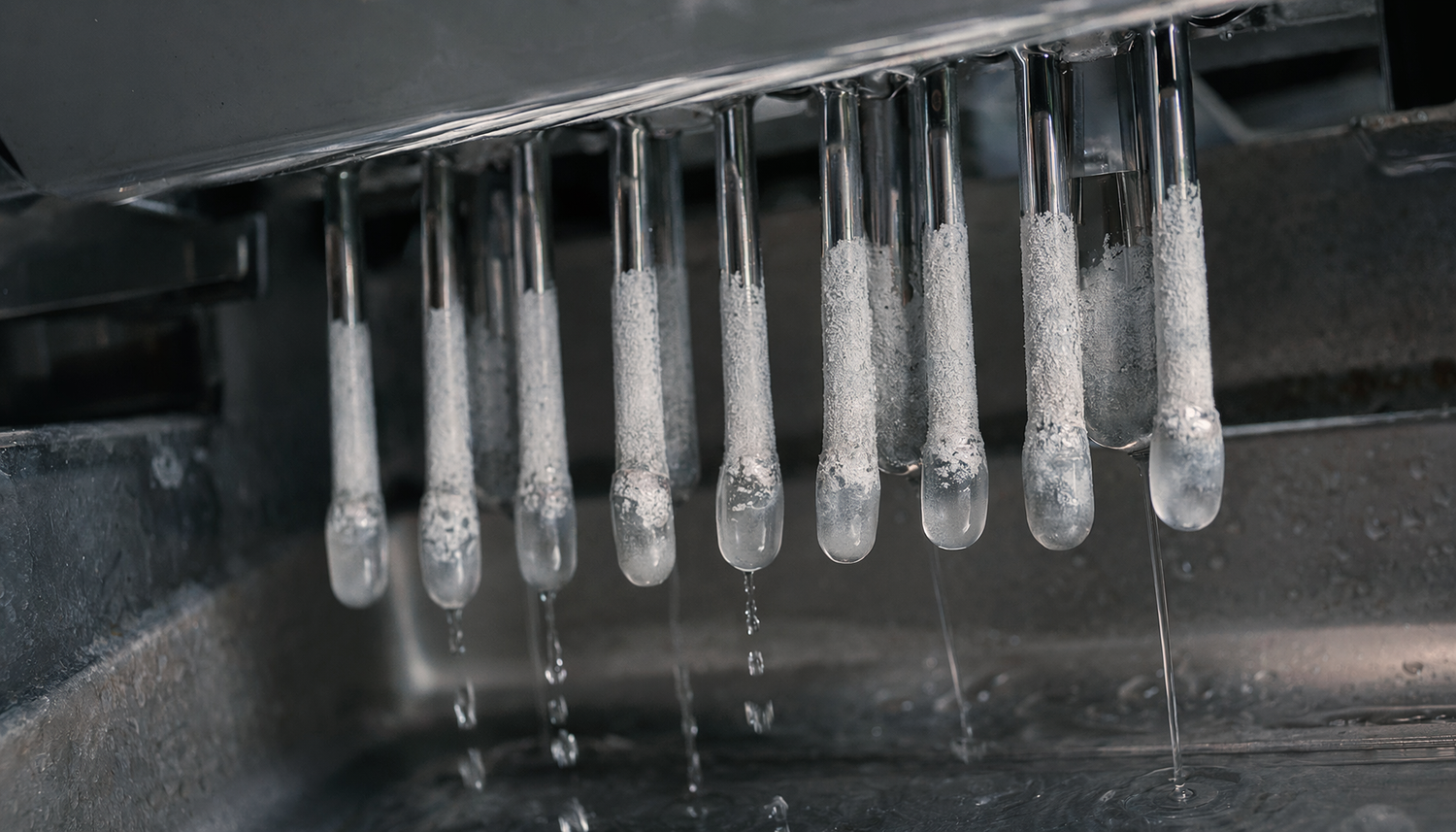
Hard water can slow an ice maker down, cloud the ice, and leave residue behind because calcium and magnesium build up on the parts that freeze and move water.
If your countertop unit suddenly takes longer to drop a batch or your cubes start looking chalky, the water in the reservoir is often part of the problem. Normal startup timing is usually around 6 to 15 minutes depending on ice style, and it often settles after 2 to 3 harvests, so ongoing slow cycles usually point to water temperature, airflow, or mineral film instead of simple startup lag. You will see where hardness changes the freezing cycle, how it affects taste and appearance, and when filtration, softening, or descaling makes sense for home, travel, or light-business use.
What Water Hardness Actually Changes Inside an Ice Maker

Hard water mainly comes from dissolved calcium and magnesium, and many U.S. water references treat water as clearly hard once it moves past about 120 mg/L as calcium carbonate. Some utilities use slightly different labels, but the practical takeaway is the same: the more mineral-heavy the water is, the more likely it is to leave visible deposits behind in an ice maker.
In a portable ice maker, that mineral load stays in a small reservoir and gets reused over repeated batches, so minerals can concentrate as water freezes and melts back into the system. In a commercial machine, the same issue shows up across a larger water path, including fill valves, troughs, pumps, distributors, evaporator surfaces, and sensors. That is one reason water hardness is a defined ice-maker test condition in federal test procedures for automatic commercial ice makers, right alongside ambient temperature, water temperature, and water pressure.
For real use, this means the same machine can behave differently in different homes or job sites. A portable unit used in an apartment with slightly hard water may stay predictable for weeks, while the same unit used in an RV park, coastal rental, or small office with harder water may need more frequent cleaning and produce more visible residue.
Why Hard Water Slows Freezing

Heat transfer gets worse when scale coats the cold surface
Cold refrigerator water can shorten the first 2 to 3 cycles, because the machine has less heat to remove before ice starts forming. The opposite is also true: warm feed water slows freezing, and hard water makes that slowdown worse over time because the mineral film left on the evaporator and water path acts like insulation. Even a thin layer can reduce how efficiently the machine pulls heat out of the water.
That matters in both portable and commercial designs. Countertop machines often freeze water on metal prongs or chilled trays, while larger commercial units may build ice on an evaporator grid or cold plate. In both cases, the freezing surface works best when water is moving cleanly over bare metal. Once scale covers that surface, freeze times lengthen, harvests can become less consistent, and back-to-back production falls off.
Water movement and control parts can also be restricted
Scale does not just sit on the freezing surface. It can collect on valve screens, distributor holes, pump impellers, water level probes, and ice thickness sensors. In practice, that can mean slower fills, uneven water coverage, underfilled molds, or sensors ending a freeze cycle before the batch is fully formed. On a portable unit, the symptom may look like smaller or softer cubes. On a commercial unit, it may show up as irregular cube size, longer harvest times, or frequent service calls.
This is why hard-water problems often feel mechanical even though the root cause is the water itself. If the machine is level, ventilated, and otherwise sound, but production still drifts lower over time, mineral buildup is one of the first places to look.
Why Hard Water Changes Ice Appearance and Taste

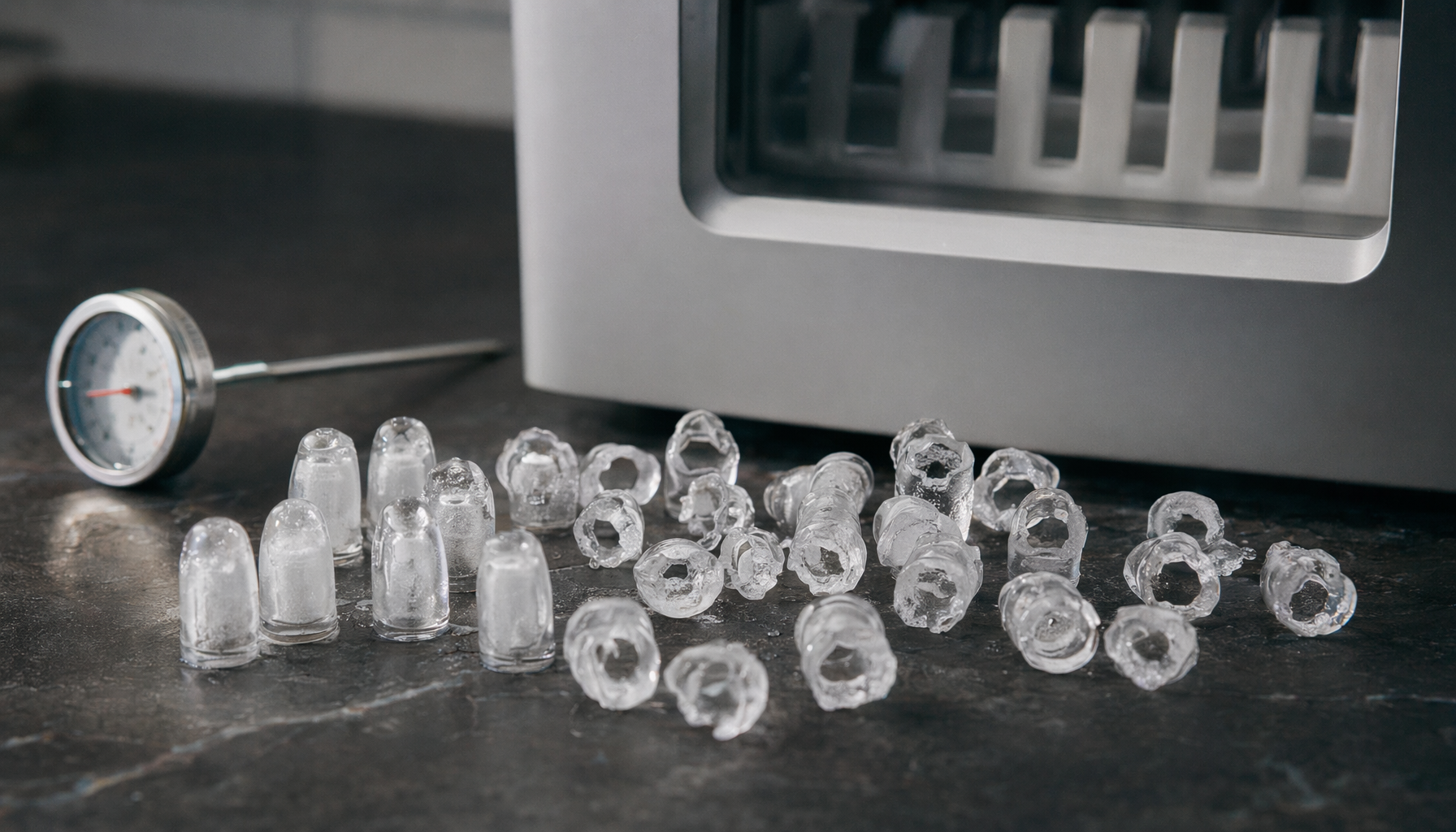
Freezing hard water can leave visible white particles as the ice melts, and that same mineral content can make cubes look cloudy instead of clear. Some of that cloudiness comes from dissolved minerals getting trapped as the outside freezes first and pushes impurities inward. In everyday use, cloudy cubes are often the first warning that the water source or the machine interior needs attention.
Taste can shift too, especially in ice used for coffee, iced tea, whiskey, soda, or plain drinking water. Taste or odor problems can also come from poorly maintained refrigerator filters, older plumbing, new plumbing materials, hoses, or containers, so “bad ice” is not always just a freezing issue. If the water tastes flat, metallic, plasticky, or chalky before freezing, the ice will usually carry some version of that flavor into the drink.
For beverage-focused setups, that trade-off matters more than many buyers expect. A compact ice maker beside a beverage cooler in a guest room, camper, or office break room may produce enough volume, but if the source water is inconsistent, the drinks still suffer. A good rule is simple: if you would not want to drink the water plain, do not expect the ice to improve it.
Choosing the Best Water Source for Portable and Commercial Ice Makers

Start with the least complicated fix that matches your water
Most households do not automatically need a water softener, even when the water is moderately hard. If your local supply is only slightly hard to moderately hard, a portable ice maker may run well with cold filtered water and regular descaling. If you are in a clearly hard or very hard water area, or if scale returns quickly after cleaning, then source-water treatment becomes much more relevant.
For a countertop unit at home, the most practical first step is usually cold drinking water from the refrigerator dispenser, a filter pitcher, or another clean low-sediment source. For a commercial ice maker serving an office kitchen, coffee counter, or light catering setup, it is usually smarter to treat the incoming water before it ever reaches the machine, rather than relying on cleanup after scale has already formed.
Filtration, softening, and reverse osmosis each solve different problems
Ion-exchange softeners remove calcium and magnesium, which directly addresses scale formation. That makes softening useful in hard-water areas where freeze times keep slipping, scale returns fast, or valves and sensors are repeatedly affected. The trade-off is that softening adds some sodium to the water, uses salt, and consumes water during regeneration, so it is not automatically the best fit for every household or every taste preference.
Reverse osmosis can remove minerals including calcium and magnesium, which is helpful when you want very low-mineral water for cleaner-tasting ice and less scale. The trade-off is efficiency: some systems use substantial extra water, potentially hundreds of gallons per month, and production can be slower than simply filling from a cold tap. For many homes, that makes RO a targeted choice rather than a default one.
Water option |
What it helps with |
Main trade-off |
Best fit |
Cold filtered drinking water |
Better taste, less sediment, fewer startup delays than warm tap water |
Does not always remove enough hardness minerals |
Portable ice makers at home, in apartments, RVs, or guest spaces |
Softened water |
Strong reduction in calcium and magnesium scale |
Adds some sodium and requires softener upkeep |
Hard-water homes and commercial machines with recurring scale |
Reverse osmosis water |
Very low mineral content and cleaner-tasting ice |
Wastes more water and may cost more to install and maintain |
Clear-ice priorities, coffee programs, and chronic hard-water locations |
One more practical point: use the cold side of the plumbing, not hot water from a faucet. Hot water can bring more heater-related debris into the fill water, and it still gives the machine more heat to remove before freezing begins.
Matching Maintenance to Home, Travel, and Light-Business Use

Chalky residue or cloudy ice is a sign to descale and rinse thoroughly, not just to wipe the basket and keep going. In portable models, descaling with a mild citric-acid solution is a practical way to remove mineral film from the water path and freezing surfaces, and a full rinse matters so the next batches do not pick up any cleaning taste. If slow production continues, a basic reset with fresh cold filtered water and two full harvests is a useful check before assuming a part has failed.
Usage volume should drive the cleaning rhythm. A countertop machine used for weekend drinks or an occasional road trip can usually be managed by watching for cloudy ice, chalky film, or slower cycles and cleaning as those signs appear. A machine supporting an office break room, small event space, or daily beverage service will show hard-water problems sooner because it is running more cycles and concentrating more minerals over time.
Commercial machines deserve the most disciplined routine. In harder-water locations, service intervals can shrink fast because scale affects not only ice quality but also sensors, pumps, and fill behavior. If you are pairing an ice maker with a beverage cooler, wine cooler, or car refrigerator for mobile use, keep a separate gallon of the same filtered drinking water you plan to use for refills. Consistent water input usually gives you more consistent ice output.
FAQ
Q: Can hard water make an ice maker freeze more slowly? A: Yes. Hard water leaves mineral film on the surfaces that remove heat from the water, and that film reduces heat transfer. It can also restrict valves, pumps, and water flow, which makes the freeze cycle less efficient.
Q: Is cloudy ice always caused by hard water? A: No. Hard water is a common cause, but cloudy or off-tasting ice can also come from old filters, plumbing residue, containers, or poor cleaning inside the machine. If the water itself tastes or smells off, the ice usually will too.
Q: Should I use softened water or filtered water in a portable ice maker? A: It depends on the problem you are solving. Filtered cold drinking water is often enough for light home use and taste improvement, while softened or RO-treated water is more useful when scale buildup is frequent or your local water is clearly hard.
Final Takeaway
Water hardness affects ice makers in two main ways: it slows freezing by insulating cold surfaces, and it lowers ice quality by leaving minerals behind in the cubes and inside the machine. That matters whether you are filling a compact countertop unit for family drinks, packing a portable setup for travel, or keeping a light-commercial ice machine productive through a full workday.
For most users, the practical order of operations is straightforward: 1. Start with cold, good-tasting drinking water. 2. Watch for cloudy ice, white residue, slower batches, or uneven cube size. 3. Descale promptly instead of waiting for performance to drop further. 4. Move to softening or reverse osmosis when hardness is high enough that filtration and routine cleaning are no longer keeping up.

Laisser un commentaire
Ce site est protégé par hCaptcha, et la Politique de confidentialité et les Conditions de service de hCaptcha s’appliquent.